Rooftop Wildfire Sprinklers in Canada
A practical, safety-first guide to exterior sprinkler protection: how it works, what affects coverage, and how to prepare a system as one part of a complete FireSmart plan.
How rooftop wildfire sprinklers help
Wind-driven embers can arrive before the main wildfire. A planned exterior sprinkler system helps prepare the surfaces where embers are most likely to land.
Wet vulnerable exterior surfaces
Water can pre-wet roofing, gutters, decks, siding and nearby vegetation, making dry materials less receptive to wind-blown embers.
Raise humidity around the structure
Strategically placed sprinklers can create a more humid zone around a building and help reduce the chance that embers ignite combustible material.
Clear combustible material, maintain the home ignition zone and follow local emergency directions.
The key idea: rooftop sprinklers add a valuable layer of exterior protection, but they do not replace evacuation orders, FireSmart work or professional emergency response.
What “humidity bubble” protection means
Wet vulnerable surfaces
Water can moisten roofing, siding, decks and nearby vegetation before embers arrive.
Cover more than one point
A well-planned spray pattern helps reduce dry gaps around the parts of a structure most exposed to embers.
Prepare early
Equipment should be selected, tested and practised with before an emergency—not while evacuation is underway.
Expect changing conditions
Wind, roof height, water pressure and available flow all affect real-world coverage.
No-ladder deployment: why it matters
Deploying from the ground helps avoid roof-climbing hazards and saves valuable setup time. Water Winger is designed to be pulled into position from the ground, without carrying sprinkler equipment up a ladder.
Stay on the ground
Send the deployment line over the roof, then use it to pull the Water Winger smoothly to the roof peak. This keeps the user off the roof during setup.
Practise before wildfire season
Learn the rope, hose and pull route in calm, safe conditions. A practised setup is faster, easier to correct and less likely to snag.
Safety first: Keep clear of overhead power lines, never deploy in unsafe conditions, and stop if the system cannot be positioned safely. Watch the deployment videos for hand-thrown and launcher-assisted methods.
Plan water pressure, flow and coverage
Pressure pushes water outward. Flow determines how much water is available. Every added sprinkler shares the available supply, so pressure, total GPM and hose losses must be planned together.
Pressure
Water Winger’s published operating guidance uses approximately 40–80 PSI. Nozzle choice, hose length, elevation and fittings all affect the pressure that reaches the sprinkler.
Flow
At about 50 PSI, a standard Water Winger uses roughly 7–9 gallons per minute. Confirm that the water source can sustain the combined demand of every operating sprinkler.
Coverage
Under suitable conditions, spray may reach approximately 100 feet in diameter. Wind, pressure, roof height and obstructions can reduce actual coverage.
Water source
Municipal water, a suitable well, tank or portable pump may work when it can provide the required pressure and continuous flow.
Plan with tested values: Do not rely on maximum figures. Test the exact water source, hose, fittings, elevation and sprinkler combination you intend to use.
Hose flow, friction loss and elevation
Hose has no single GPM rating. Actual flow depends on pump pressure, hose length, elevation, fittings and sprinkler demand. These planning values show why larger hose is important on long or uphill runs.
| Hose size | Friction loss per 100 ft | Practical use |
|---|---|---|
| 5/8 in. | 10 GPM: 20 psi 20 GPM: 80 psi |
Short, low-flow branch lines |
| 3/4 in. | 10 GPM: 11 psi 20 GPM: 44 psi 30 GPM: 99 psi |
Short home loops and branch lines |
| 1-1/2 in. | 20 GPM: 1 psi 50 GPM: 9 psi 70 GPM: 17 psi 100 GPM: 35 psi |
Long feeds and high-flow pump systems |
Simple sizing formula: pump pressure = sprinkler pressure + hose friction loss + elevation loss.
Example: At 20 GPM through 200 ft of hose with a 50 ft rise and 50 psi required at the sprinkler, 3/4 in. hose needs about 163 psi; 1-1/2 in. hose needs about 77 psi. Larger supply hose protects usable pressure.
Planning values: USDA Forest Service wildland hose-loss guide. Always test the complete installed system.
Popular pump performance: flow versus pressure
A pump produces less flow as pressure, elevation and hose friction increase. Open any card to see the graph; use the download button for the manufacturer information sheet.
Select your pump
Click a pump picture to use that model in the simulator.

WATERAX MARK-3
Four-stage backpackable pump for extreme elevation and very long hose lays.

WATERAX STRIKER-2
High-head vehicle-mount option for major rise or very long hose lays.

WATERAX VERSAX VS2-9W
Higher pressure for steeper elevation, longer hose and greater demand.

WATERAX VERSAX VS2-6W
Dependable two-stage choice for long hose runs and multiple sprinklers.

BE WS1565H
Compact Honda GX200 wildland pump for controlled spray support.

BE HPFC-2065HR cart pump
Mobile Honda GX200 kit with suction hose, fire hose and nozzle.
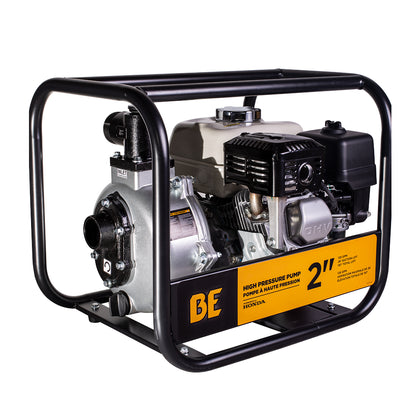
BE HP-2065HR
Honda GX200 transfer pump available through Lordco.

WATERAX MINI-STRIKER
Ultra-portable 20 lb pump for smaller sprinkler layouts.
Honda WH20XTC reference
Higher-flow reference pump for larger supply hose.
Honda WH15XT2C reference
Compact reference option for short, lower-loss layouts.
Official references: WATERAX Product Guide, BE Power Equipment, and Honda Canada.
Design Your Wildfire Sprinkler System
Choose a water source or pump, enter hose distance and elevation, select exact rooftop and ground sprinkler quantities, then compare hose sizes, qualifying pumps and available system capacity.
A practical preparation checklist
- Start with FireSmart. Clear combustible material from the immediate area around the home and complete the highest-priority recommendations for your property.
- Assess the water source. Confirm pressure, sustained flow, connection sizes and backup needs.
- Map the system. Plan sprinkler locations, hose routes and shutoffs without blocking exits or vehicle access.
- Test in safe conditions. Practise ground deployment, inspect hoses and confirm the real spray pattern.
- Maintain readiness. Store components together, replace damaged parts and review the plan each season.
- Follow authorities. Deploy only when permitted and safe. Obey evacuation alerts, orders, fire bans and local instructions.
Choose a setup for your situation
Community groups
Scalable equipment for neighbourhood and community preparedness.
Structure protection crews
Equipment packages for trained professional deployment.
Need help choosing?
Tell us about the property, water source and intended coverage.
Frequently asked questions
Do rooftop sprinklers replace FireSmart work?
No. Exterior sprinklers are most effective as one layer of a larger FireSmart plan. Reduce combustible material and maintain the home ignition zone first.
When should a system be deployed?
Prepare and practise well before wildfire season. During an incident, follow local officials and deploy only when it is permitted and safe. Never delay evacuation.
Can one person deploy a rooftop sprinkler?
Some no-ladder systems are designed for ground deployment by one prepared user, but larger properties and multi-unit setups are generally easier with trained help.
Can a well supply the system?
Possibly. The well and pump must provide enough sustained pressure and flow for every sprinkler operating at the same time. Test the complete setup.
Is the system permanent?
Water Winger rooftop sprinkler kits are portable and can be stored between uses. Local requirements and conditions may affect where and when equipment can be installed.
Important safety note
Exterior sprinklers cannot guarantee that a structure will survive a wildfire. Fire behaviour, wind, fuel conditions, water supply and emergency access can change quickly. Follow all evacuation orders and instructions from local authorities. Never remain in a threatened area to install, adjust or operate equipment.
Official Canadian resources
- Province of BC: Structure Protection and Structure Defence
- BC Wildfire Service: Structure protection during wildfire season
- FireSmart BC
Last reviewed August 2026. Product specifications and local emergency guidance can change; confirm current information before relying on it.